How to Appear in Google AI Overviews: 7 Tactics That Work (2026)
To get featured in Google AI Overviews, you need to structure your content for machine extraction — clear headings, direct answer sentences, FAQ sections, and schema markup. AI Overviews now appear across a significant share of searches and are reshaping how organic traffic reaches websites. Appearing in them is no longer a bonus; it is a core part of any 2026 SEO strategy.
Whether you are watching your click-through rates fall despite stable rankings or preparing your content for an AI-first search landscape, this guide covers the exact tactics that increase your probability of earning a citation slot in Google's AI-generated responses.
In this guide, we will cover:
- What Google AI Overviews are and how they work
- What types of content Google features in AI Overviews
- 7 specific tactics to optimise for AI Overviews
- What NOT to do (3 common mistakes)
- FAQs about AI Overviews and SEO
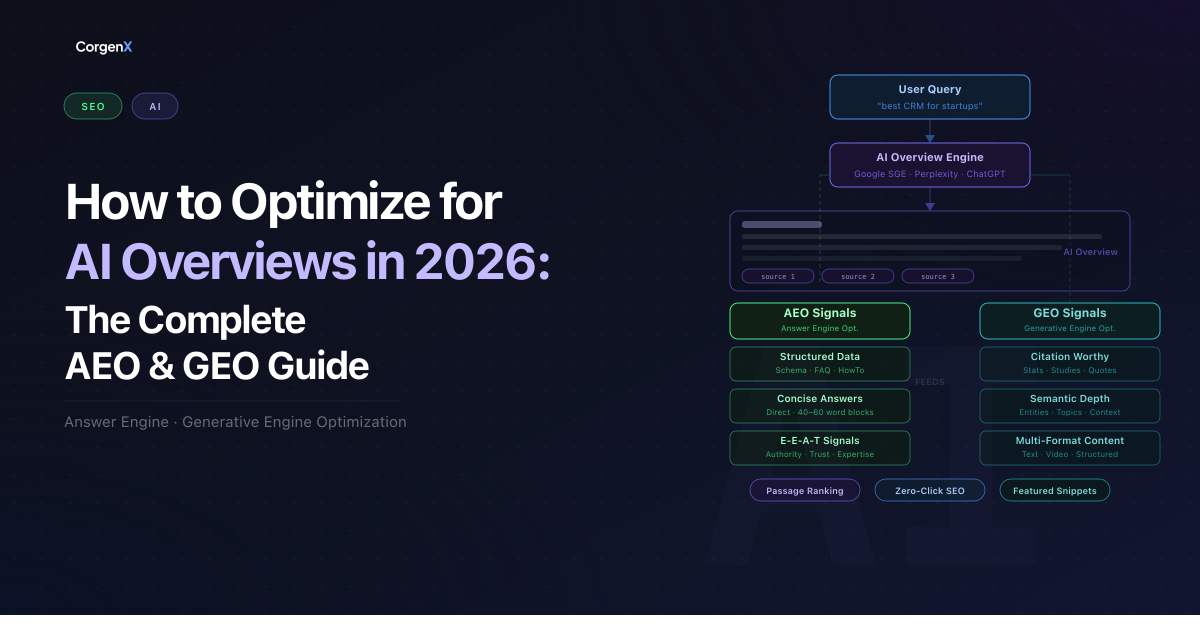 How to Appear in Google AI Overviews: 7 Tactics That Work (2026)
 Figure 1: The AI Overview Citation Model — how Google synthesizes multiple sources into a single response, and where your content needs to be to earn a citation slot.
What Are Google AI Overviews and How Do They Work?
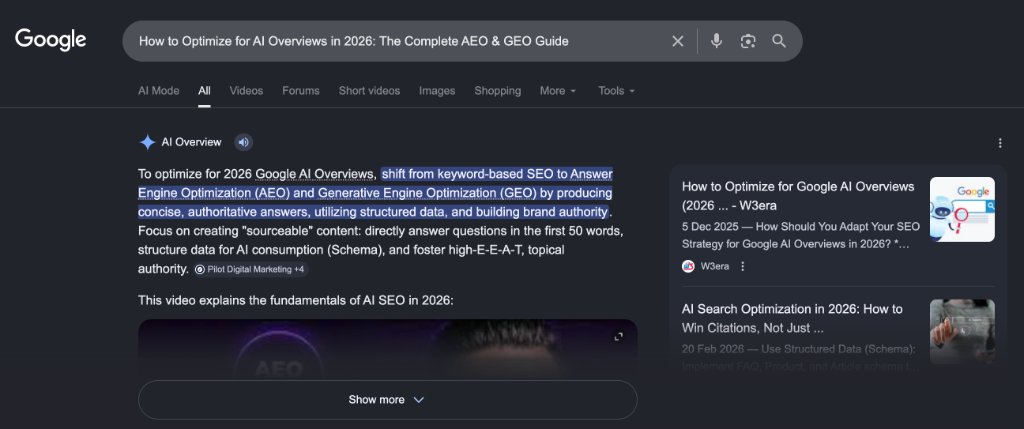 Figure 2: A real-world Google AI Overview — note the synthesized answer and prominent source citations.
Google AI Overviews (formerly Search Generative Experience, or SGE) are AI-generated summaries that appear at the very top of Google search results — above paid ads, above featured snippets, and above every organic result you have spent years optimising to rank. They synthesize information from multiple sources across the web into a single, cohesive answer, with inline citations that link back to the original content. You do not rank in an AI Overview in the traditional sense; you earn a citation slot inside a response that a user may read without ever clicking through to your page.
AI Overviews appear to use a process similar to Retrieval-Augmented Generation (RAG) — a two-stage approach where Google first retrieves relevant documents, then uses a generative model to synthesize them into a natural-language response. First, Google retrieves a pool of relevant, high-authority documents matching the query. Then, the generative model synthesizes those documents into a natural-language response, citing the sources it found most useful. What this means in practice: you are no longer competing only for position one. You are competing to be selected as a source that an AI trusts enough to cite. That is a different game — and it favours content that is structured for extraction, not just content that is comprehensive.
What Types of Content Google Features in AI Overviews
AI Overviews do not favour all content formats equally. Google's systems are specifically optimised to extract and surface certain content structures. Understanding what those are is the first step to appearing in them.
Definitions and direct answers are among the most commonly cited formats. A clear, one-sentence definition placed right after a heading — "A broken link is a hyperlink that leads to a destination returning a 404 error" — is far more extractable than the same definition buried in the middle of a paragraph.
Numbered step-by-step instructions are consistently featured for how-to queries. Any process structured as discrete numbered steps is easy for the AI to extract and present as a clean answer.
Bullet-point lists — grouped causes, examples, tips, or options — are pulled into AI Overviews regularly because the list format matches how AI systems present grouped information.
Comparison tables are extracted directly when comparing options, tools, or approaches. A well-structured table with clear column headers is highly citation-friendly.
FAQ-style question-and-answer pairs are one of the highest-citation-rate formats in AI Overviews. The structure mirrors the query-response model that AI systems are built around — a clearly stated question with a self-contained answer directly below it.
Content that buries the answer, relies on reader context, or uses dense walls of prose consistently loses out to structured alternatives — even when the prose is more thorough.
7 Tactics to Optimise for Google AI Overviews
1. Use Structured Content with Clear Headings
AI systems parse content structurally. They look for clearly defined sections where the heading signals what question is being answered and the content beneath answers it directly — without requiring context from the sections before or after it.
Use H2 and H3 headings that describe the answer, not just the topic. "How to submit a sitemap to Google" is a better heading than "Sitemap submission." Make every major section self-contained: if the AI extracts only that section and nothing else, the reader should still get a complete, accurate answer. Headings phrased as questions ("What causes a broken link?") perform particularly well because they directly match the query structure that triggers AI Overviews.
2. Write a Direct Answer Sentence at the Start of Each Section
The single highest-impact structural change you can make is placing the key answer at the very top of each section — before any supporting explanation. AI systems are optimised to find the most useful response to a query, and they find it faster in content that opens with the answer than content that builds toward it.
The pattern is: heading → direct one-sentence answer → supporting explanation. If a reader — or an AI crawler — reads only the first sentence under each heading, they should come away with a complete, accurate answer to the question that heading implies. Content that saves the answer for the end of the section is structurally invisible to AI extraction.
3. Add a Structured FAQ Section to Every Article
FAQ sections are one of the most reliably cited content formats in AI Overviews because they directly mirror the query-response structure that AI systems are built around. A clearly stated question paired with a self-contained answer is exactly what the AI is looking for when it needs to synthesize a response.
Every article you publish should include a FAQ section at the bottom with at least five relevant questions. Write each answer as a standalone paragraph — complete, precise, and no longer than 60–80 words. Each answer should be readable and accurate with no surrounding context. Mark FAQ sections up with FAQPage schema so Google's AI can parse the structure programmatically, not just visually.
4. Implement Schema Markup
Schema markup is the most direct technical signal you can send to Google's AI systems. It tells crawlers exactly what type of content is on the page and what each element represents — before the AI model has to infer it from the prose.
The schema types with the highest impact on AI Overview citation rates in 2026:
- FAQPage schema — Mark up every FAQ section with structured
QuestionandAnswerpairs. These remain heavily used by AI systems for parsing structured question-answer content. - HowTo schema — For any step-by-step guide or process article with discrete steps.
- Article schema — With
author,datePublished, anddateModifiedfields. This reinforces E-E-A-T signals programmatically and signals freshness. - BreadcrumbList schema — Helps AI understand your site's topical hierarchy and content relationships.
Schema markup alone will not guarantee a citation — but its absence is one of the fastest ways to be passed over in favour of a competitor who has it.
5. Keep Paragraphs Short — Under 60 Words
Dense paragraphs are rarely extracted by AI systems. When Google's model is synthesizing an answer from multiple sources, it selects the clearest, most precise chunk of content that directly addresses the query. A 200-word paragraph that makes three points is harder to extract accurately than a 50-word paragraph that makes one point clearly.
The practical rule: one idea per paragraph. If a paragraph is making multiple points, adding caveats, and then concluding — split it into separate paragraphs for each. Short paragraphs are not a stylistic preference in AI-era SEO; they are a structural requirement. Walls of prose get skipped; clear, atomic statements get cited.
6. Include Original Data or Statistics
AI Overviews consistently cite content that contains specific, verifiable data points. "Cart abandonment averages 70% globally" is citation-worthy. "Many users abandon their carts" is not. Specificity signals that your content is grounded in real evidence, which is exactly the signal AI systems weight when selecting which sources to cite.
Original data — your own research, survey results, A/B test findings, or internal analysis — is especially powerful because it is unique: the AI cannot synthesize that specific data from any other source. Even citing well-sourced third-party statistics with an inline link to the original study improves citation probability, because it demonstrates that your claims are verifiable — a signal both AI systems and human readers reward.
7. Build Strong E-E-A-T Signals
E-E-A-T (Experience, Expertise, Authoritativeness, Trustworthiness) is how Google evaluates whether your content is credible enough to cite in an AI Overview. Lower-ranking content with strong E-E-A-T signals can earn citations over top-ranked pages that lack them — which makes E-E-A-T one of the highest-leverage levers available outside of traditional SEO.
Key E-E-A-T improvements for AI Overview optimisation:
- Named author with credentials — Every article needs a byline with a bio that states specific expertise, not a generic "admin" or "staff writer"
- First-hand experience markers — Include real results, case data, or direct experience throughout. AI systems increasingly distinguish between original experience and third-party summary.
- External citations within your content — Link to authoritative external sources: studies, official documentation, industry data. This signals that your claims can be verified.
- Content freshness — AI Overviews favour recently updated content. Add a
dateModifiedfield to your schema and genuinely update key articles quarterly. - Brand mentions in third-party publications — References to your brand in authoritative external sources improve citation probability more than raw backlink count.
What NOT to Do When Optimising for Google AI Overviews
1. Do Not Block AI Crawlers in Your robots.txt
If Google's crawler — or any major AI crawler — cannot access your content, it cannot be cited. Check your robots.txt file to confirm you are not blocking GPTBot, PerplexityBot, ClaudeBot, or Bingbot. This is the most silent and most damaging technical error in AI search optimisation: your content is perfectly structured, but invisible to the systems you are trying to reach.
2. Do Not Bury Your Answers in Long Introductions
AI systems extract the most relevant response to a query — they do not read your entire post to appreciate the buildup. A 300-word introduction before your first substantive answer means the AI may skip your content entirely and cite a competitor who answered the question in the first sentence. Every section should earn its citation in the opening line.
3. Do Not Abandon Traditional SEO in Favour of AI Optimisation Alone
AI Overviews are primarily populated from the organic top-10 results. Content that does not rank well in traditional search is rarely cited — regardless of how well it is structured. Your schema markup, E-E-A-T signals, and content formatting are multipliers on top of an existing SEO foundation, not replacements for one. Fix your technical SEO, earn authoritative backlinks, and build topical authority before optimising specifically for AI citations.
FAQs
What are Google AI Overviews?
Google AI Overviews are AI-generated summaries that appear at the top of Google search results, above traditional organic listings. They synthesize information from multiple high-quality sources across the web into a single, cohesive answer, with inline citations linking to the original pages. They appear on a significant portion of searches and directly reduce click-through rates on informational queries by answering the question before the user clicks through to any result.
Do I need to rank in the top 10 to appear in Google AI Overviews?
Not always, but it significantly helps. AI Overviews currently pull primarily from Google's organic top-10 results. However, pages with strong E-E-A-T signals, comprehensive schema markup, and clearly structured, answer-first content can occasionally earn citations even from positions outside the top 10. In practice, the highest-probability path to AI Overview citations is improving your organic ranking alongside your content structure — both simultaneously.
Does schema markup directly cause Google to feature my content in AI Overviews?
Schema markup does not guarantee an AI Overview citation, but its absence makes citation significantly less likely. FAQPage and HowTo schema give Google's AI pre-formatted, machine-readable content to extract — reducing the processing required and increasing the likelihood that your structured content is selected over a competitor's unstructured prose covering the same topic. Think of schema as a signal that makes your content easier to trust and cite.
How long does it take to appear in Google AI Overviews after making these changes?
Initial citation visibility typically appears somewhere between four and twelve weeks after implementing structured content formatting, FAQ sections, and schema markup — though Google has not published official timelines for AI Overview updates, so this varies by site, topic, and competition. Building the underlying E-E-A-T and topical authority signals takes longer — typically three to six months of consistent effort. The good news is that structured data is processed quickly by Google's crawlers; the bottleneck is usually the authority signals, not the technical implementation.
Can I lose an AI Overview citation once I have earned it?
Yes. AI Overviews update their citations regularly. Pages that become outdated, lose their schema markup, drop in authority, or are outperformed by fresher, better-structured content from a competitor can lose citation status. Regular content updates — at minimum quarterly for key articles — along with current statistics and maintained E-E-A-T signals are what keep you in the citation rotation over time.
Related Articles
Ready to Scale?
Our high-performance web solutions and SEO strategies are designed to deliver results.
Check out our services